
Appearance
Oscillators
Oscillators are the raw sound sources of MNodes. Each one repeats a wave shape over and over at a pitch you choose, giving you a basic tone that you then shape with filters, envelopes and effects. This page covers the classic wave shapes (sine, saw, triangle, square and pulse), three "colours" of noise, and two phase ramp generators (steady timing signals) you can use to keep oscillators, LFOs and wavetables all running in step. On the wave-shape oscillators, the Frequency and Phase controls can be driven by other nodes at audio rate: wire a signal into Frequency for FM, into Phase for phase modulation (PM), or into a Pulse's Width for PWM, plus other moving, shifting textures.
Sine
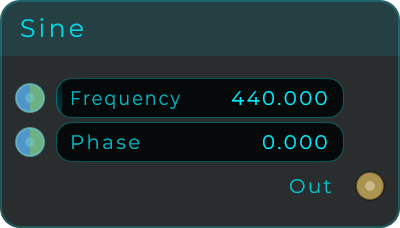
The purest tone there is, with no extra harmonics added on top. It is perfect as a deep sub layer, as a building block for FM sounds, as a tuning reference, or as a smooth, slow control signal (an LFO) once you drop its frequency below 20 Hz.
| Parameter | Range | Default | Description |
|---|---|---|---|
| Frequency | 0 - 20,000 Hz | 440 Hz | Pitch of the tone, in Hz |
| Phase | 0.0 - 1.0 | 0.0 | Phase offset in cycles. Handy for aligning several oscillators |
Inputs: Frequency (Data, stream-capable), Phase (Data, stream-capable) Outputs: Out (Audio)
Saw
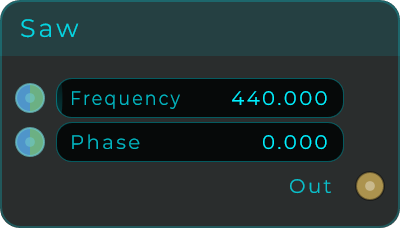
A bright, buzzy tone that contains the full set of harmonics. It is the classic starting point for leads, basses, strings and big supersaws: run it through a low-pass filter for smooth, warm analog tones, or stack slightly detuned copies for a thick, layered sound.
| Parameter | Range | Default | Description |
|---|---|---|---|
| Frequency | 0 - 20,000 Hz | 440 Hz | Pitch of the tone, in Hz |
| Phase | 0.0 - 1.0 | 0.0 | Phase offset in cycles. Handy for aligning unison voices |
Inputs: Frequency (Data, stream-capable), Phase (Data, stream-capable) Outputs: Out (Audio)
Triangle
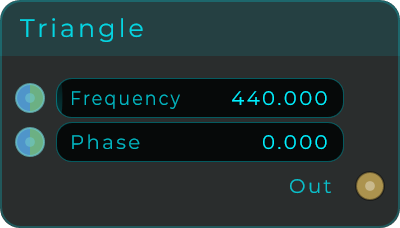
A soft, hollow tone, much mellower than a saw because it has far fewer harmonics. Good for flute-like high parts, gentle leads, subs that still poke through a little, and smooth modulation when you slow it down into LFO range.
| Parameter | Range | Default | Description |
|---|---|---|---|
| Frequency | 0 - 20,000 Hz | 440 Hz | Pitch of the tone, in Hz |
| Phase | 0.0 - 1.0 | 0.0 | Phase offset in cycles |
Inputs: Frequency (Data, stream-capable), Phase (Data, stream-capable) Outputs: Out (Audio)
Square
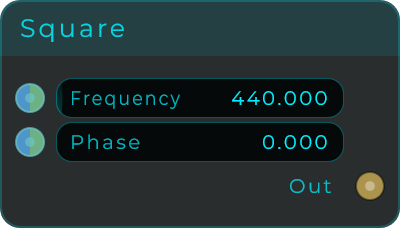
A hollow, woody tone with a strong, solid bottom end (it sits exactly halfway between on and off, a 50% duty cycle). It suits vintage-style leads, hollow basses and clarinet-like sounds, and it can also be used as an on/off trigger source for other nodes.
| Parameter | Range | Default | Description |
|---|---|---|---|
| Frequency | 0 - 20,000 Hz | 440 Hz | Pitch of the tone, in Hz |
| Phase | 0.0 - 1.0 | 0.0 | Phase offset in cycles |
Inputs: Frequency (Data, stream-capable), Phase (Data, stream-capable) Outputs: Out (Audio)
Pulse
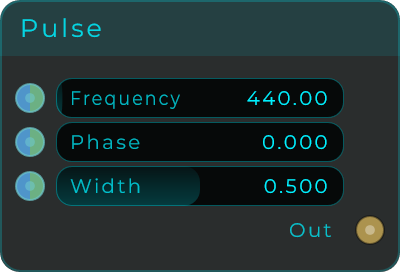
Like a square, but with an adjustable width (how long it stays on versus off, called the duty cycle). At a Width of 0.5 it is exactly a square; move Width away from 0.5 and the tone gets thinner and gains more harmonics. Have an LFO wiggle the Width back and forth for that classic shimmering PWM movement behind so many analog string and lead sounds.
| Parameter | Range | Default | Description |
|---|---|---|---|
| Frequency | 0 - 20,000 Hz | 440 Hz | Pitch of the tone, in Hz |
| Phase | 0.0 - 1.0 | 0.0 | Phase offset in cycles |
| Width | 0.01 - 0.99 | 0.50 | Pulse width / duty cycle. 0.5 gives a square |
Inputs: Frequency (Data, stream-capable), Phase (Data, stream-capable), Width (Data, stream-capable) Outputs: Out (Audio)
Phase
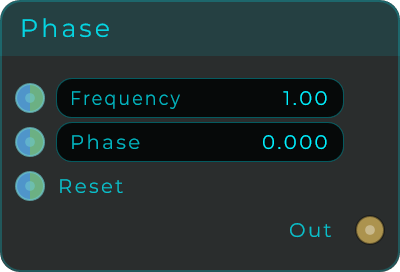
A steady ramp that rises smoothly from 0 to 1, then jumps back to 0 and starts again every cycle. This is the timing signal that sits behind every oscillator: feed it into the Phase input of oscillators or LFOs of the same shape to keep them all in step, and send a Reset event to snap the ramp straight back to zero (handy for restarting your modulation cleanly on each new note).
| Parameter | Range | Default | Description |
|---|---|---|---|
| Frequency | 0 - 20,000 Hz | 1.0 Hz | Speed of the ramp, in Hz |
| Phase | 0.0 - 1.0 | 0.0 | Phase offset in cycles |
Inputs: Frequency (Data, stream-capable), Phase (Data, stream-capable), Reset (Data event, resets the ramp to 0) Outputs: Out (Audio, a 0..1 ramp)
Noise White
White noise has equal energy at every frequency, which gives it a bright, hissy sound. It is ideal for hi-hats, snare layers, swooshes, adding texture to reverb tails, and other noise-based percussion. There are no controls: just filter it or shape it with an envelope to taste.
Inputs: none Outputs: Out (Audio)
Noise Pink
Pink noise rolls off the high end gently (3 dB per octave), so it sounds more balanced and natural to the ear. It is the same noise used to set up studio monitor speakers, and it is a more musical choice than white noise for pads, ambient beds, hi-hats and shakers. There are no controls.
Inputs: none Outputs: Out (Audio)
Noise Brown
Brown noise rolls off the highs even more (6 dB per octave), leaving a deep, bass-heavy rumble. It is perfect for wind, distant thunder, ocean waves, sleep sounds and dark low-end ambient pads, any time you want a soft, warm noise instead of a bright, hissy one. There are no controls.
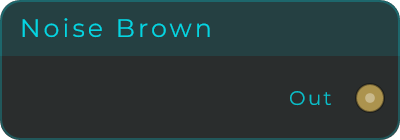
Inputs: none Outputs: Out (Audio)
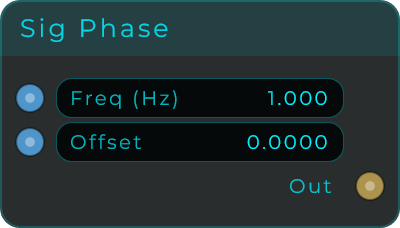
Sig Phase
A smooth ramp that rises from 0 to 1 over and over, fast enough to run at audio rate. Use it as a control signal to move other things, or feed it into the Phase input of oscillators and LFOs to keep them all locked to one shared timing source.
| Parameter | Range | Default | Description |
|---|---|---|---|
| Freq (Hz) | 0 - 20,000 Hz | 1.0 Hz | Speed of the ramp, in Hz |
| Offset | 0.0 - 1.0 | 0.0 | Phase offset in cycles |
Inputs: Freq (Data, in Hz), Offset (Data, 0..1 phase offset) Outputs: Out (Audio, a 0..1 ramp)