
Appearance
Instruments
Instruments are ready-to-play sound makers. Each one is a complete voice that turns control values, triggers or notes from your keyboard into sound, all on its own. Unlike the basic oscillators (simple tone generators), these nodes create a full, finished sound by themselves using different sound-making methods: FM, stacked harmonics, wave folding, modelling real instruments and more. Most of their knobs accept two kinds of input at once: you can turn them by hand, or have another part of your patch move them for you, even very fast. Just drop one in, send it a pitch or a trigger, and start shaping your sound.
FM Voice
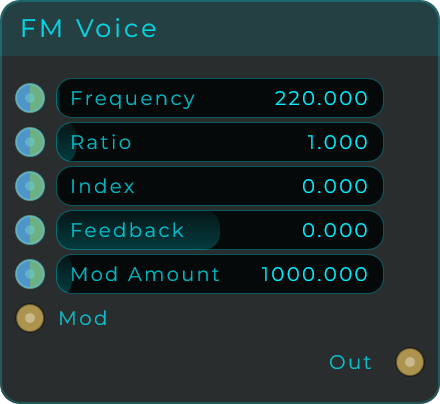
A classic FM voice built from two parts: a carrier (the tone you hear) and a modulator (a second tone that shapes the first). FM was the sound of 80s synths, so this is your go-to for electric pianos, bells, basses and bright metallic tones. Keep the Index low for a gentle sparkle, or push it high for clangy, noisy edges.
| Parameter | Range | Default | Description |
|---|---|---|---|
| Frequency | 0 - 20,000 Hz | 220 Hz | Carrier frequency, the pitch you hear |
| Ratio | 0.0 - 16.0 | 1.0 | Modulator pitch as a multiple of the carrier. Whole numbers stay harmonic; fractions go bell-like and metallic |
| Index | 0.0 - 32.0 | 0.0 | How strongly the modulator deflects the carrier. 0 is close to a pure sine; raise it for buzz and bite |
| Feedback | -2.0 - 2.0 | 0.0 | Feeds the modulator back into itself for noisier, more aggressive timbres |
| Mod Amount | 0 - 20,000 Hz | 1,000 Hz | Depth in Hz of the external FM coming from the Mod input |
Inputs: Frequency, Ratio, Index, Feedback and Mod Amount (all hybrid Data+CV), plus Mod, an optional external audio input that adds further frequency modulation scaled by Mod Amount. Outputs: Out (mono audio).
Additive
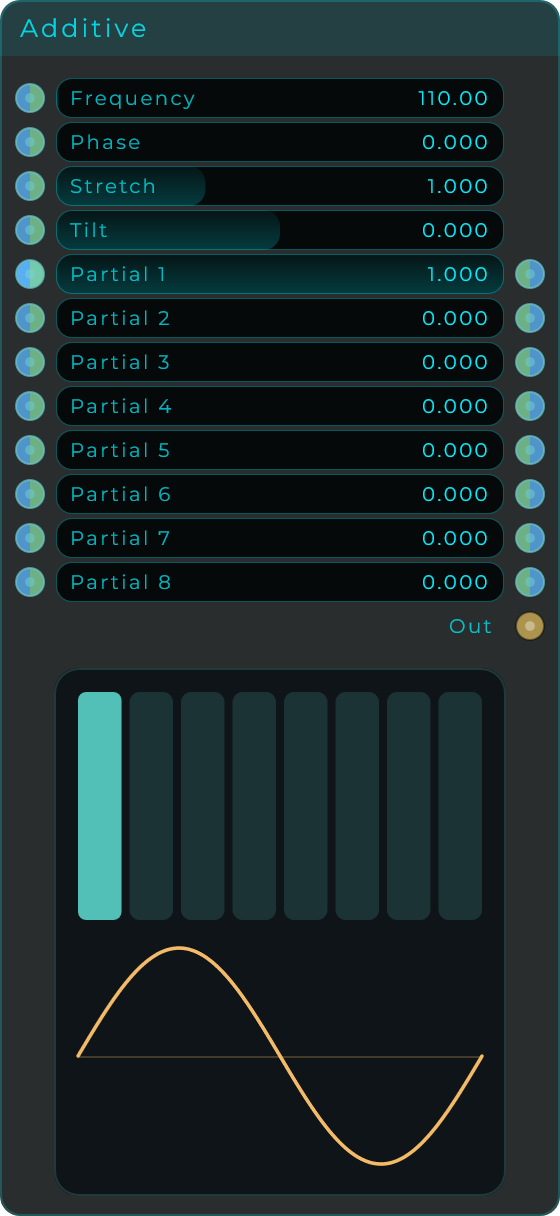
This instrument builds its sound by stacking up pure tones (harmonics) and letting you set the level of each one by hand. It is the natural choice for clean organ sounds, bell-like tones, or any rich harmonic blend you can imagine.
Partials sets how many it stacks, from 1 to 100. The node grows to match: each partial you add brings its own level row, its own CV input and its own level output, and the bars in the body follow. Start at the default 8 for organ and simple harmonic work and raise it when you want a detailed spectrum; a partial left at 0 costs nothing to run, so the count is about how much control you want on screen, not about CPU.
| Parameter | Range | Default | Description |
|---|---|---|---|
| Frequency | 0 - 20,000 Hz | 110 Hz | Base (fundamental) frequency |
| Phase | 0.0 - 1.0 | 0.0 | Phase offset in cycles |
| Stretch | 0.5 - 2.0 | 1.0 | Stretches or compresses the harmonic spacing. At 1.0 the series is natural; higher values spread it apart for inharmonic, bell-like tones |
| Tilt | -2.0 - 2.0 | 0.0 | Spectral tilt between low and high partials. Negative is darker, positive is brighter |
| Partials | 1 - 100 | 8 | How many partials the node has. Adds or removes their rows and pins |
| Partial 1 | 0.0 - 1.0 | 1.0 | Level of the first (fundamental) partial |
| Partial 2 and up | 0.0 - 1.0 | 0.0 | Level of each remaining partial |
Inputs: Frequency, Phase, Stretch, Tilt, Partials and one per partial (all hybrid Data+CV), plus an Appearance input that takes a JSON object for front-panel styling. Outputs: Out (mono audio), plus a per-partial data output for each partial so their levels can drive the rest of your patch.
Drum Synth
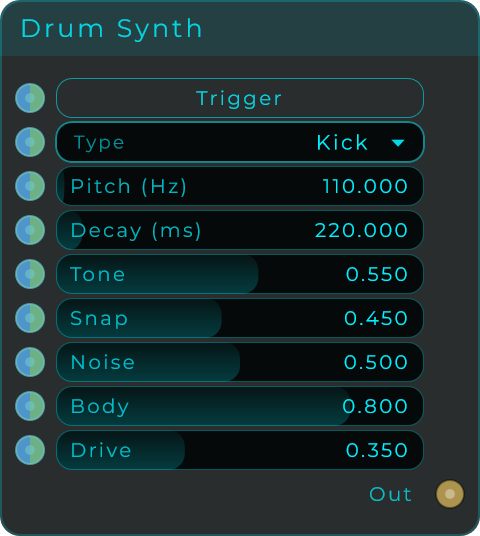
A simple drum maker with four built-in voices: Kick, Snare, Hat and Tom. Trigger it, pick the drum you want, then shape the hit with a single set of easy controls. It is a fast way to build your own drum sounds.
| Parameter | Range | Default | Description |
|---|---|---|---|
| Trigger | Event | Fires the drum hit. Also accepts a rising CV/data pulse | |
| Type | Kick / Snare / Hat / Tom | Kick | Which drum voice to synthesize |
| Pitch | 20 - 4,000 Hz | 110 Hz | Base pitch of the drum body |
| Decay | 5 - 3,000 ms | 220 ms | How long the hit takes to fade out |
| Tone | 0.0 - 1.0 | 0.55 | Overall brightness |
| Snap | 0.0 - 1.0 | 0.45 | Attack bite and pitch sweep on the transient |
| Noise | 0.0 - 1.0 | 0.50 | Amount of noise mixed into the hit |
| Body | 0.0 - 1.0 | 0.80 | Amount of resonant body tone |
| Drive | 0.0 - 1.0 | 0.35 | Output saturation |
Inputs: Trigger, Type, Pitch, Decay, Tone, Snap, Noise, Body and Drive (all hybrid Data+CV). Outputs: Out (mono audio).
Supersaw / Unison
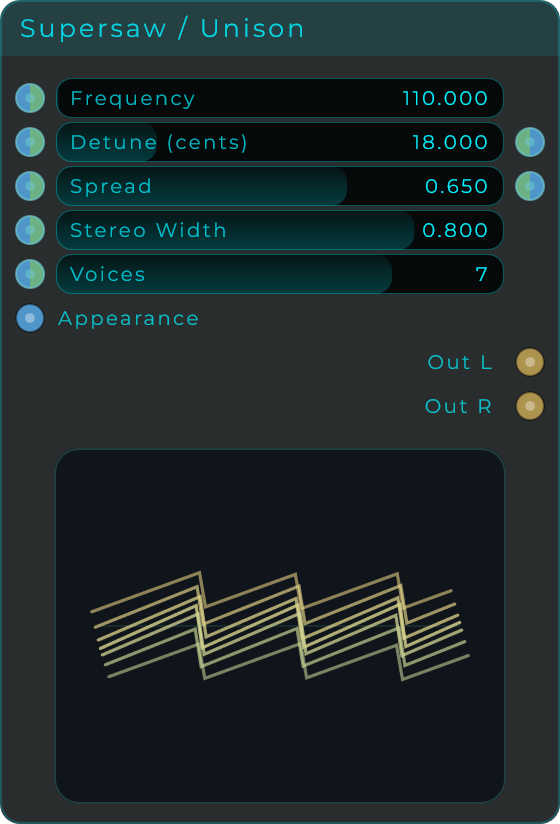
A big, wide lead sound made by layering up to nine slightly out-of-tune saw tones spread across the stereo image (left to right). This is the thick, soaring lead you hear in trance, EDM and modern hyperpop.
| Parameter | Range | Default | Description |
|---|---|---|---|
| Frequency | 0 - 20,000 Hz | 110 Hz | Base pitch |
| Detune (cents) | 0 - 80 | 18 | Maximum spread between the voices. More is thicker but less focused |
| Spread | 0.0 - 1.0 | 0.65 | How tightly or widely the detuned voices are distributed |
| Stereo Width | 0.0 - 1.0 | 0.8 | Stereo placement of the voice stack |
| Voices | 1 - 9 | 7 | Number of stacked saw voices. More is fatter but uses more CPU |
Inputs: Frequency, Detune, Spread, Stereo Width and Voices (all hybrid Data+CV), plus an Appearance input that takes a JSON object for front-panel styling. Outputs: Out L and Out R (stereo audio). Detune and Spread also have their own data outputs.
Subtractive
A full, rich voice that starts from a tone packed with harmonics and then carves it into shape. It can morph its waveform, add a deep sub layer underneath, and warm things up with gentle drive. It is meant as a strong starting point, so you can add your favourite filter later in the chain.
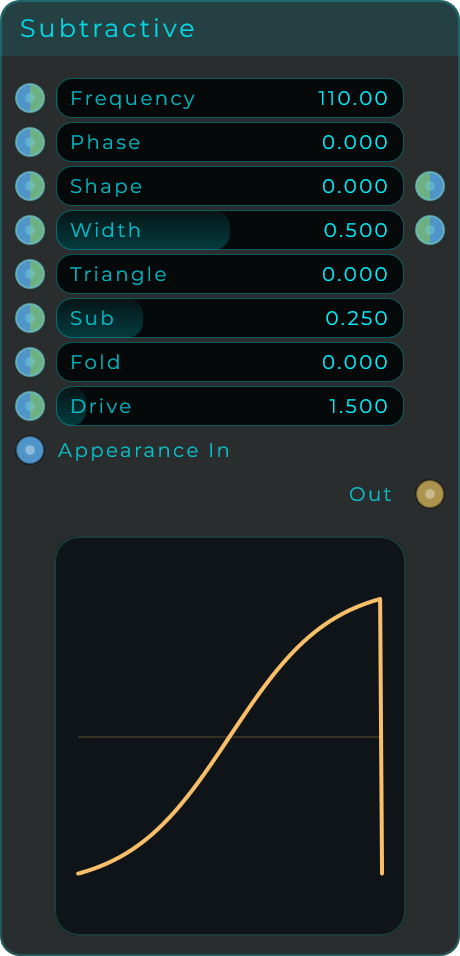
| Parameter | Range | Default | Description |
|---|---|---|---|
| Frequency | 0 - 20,000 Hz | 110 Hz | Base frequency |
| Phase | 0.0 - 1.0 | 0.0 | Phase offset in cycles |
| Shape | 0.0 - 1.0 | 0.0 | Morphs the source from saw to square |
| Width | 0.05 - 0.95 | 0.5 | Pulse width / duty cycle of the square side |
| Triangle | 0.0 - 1.0 | 0.0 | Blends a triangle layer into the source |
| Sub | 0.0 - 1.0 | 0.25 | Adds a sub oscillator one octave below |
| Fold | 0.0 - 1.0 | 0.0 | Light edge-shaping stage before the drive |
| Drive | 0.5 - 12.0 | 1.5 | Nonlinear drive for warmth and grit |
Inputs: Frequency, Phase, Shape, Width, Triangle, Sub, Fold and Drive (all hybrid Data+CV), plus an Appearance input that takes a JSON object for front-panel styling. Outputs: Out (mono audio). Shape and Width also have their own data outputs.
Wavetable
This instrument plays through a stack of different waveform shapes, sliding smoothly from one to the next. With its warp, tilt and drive controls it makes modern, ever-changing synth sounds. Pick from several built-in collections of shapes, or load your own audio file. A fresh Wavetable starts as a clean, pure sine (Classic bank, with Position, Warp and Tilt at zero and unity Drive), ready for you to shape from there.
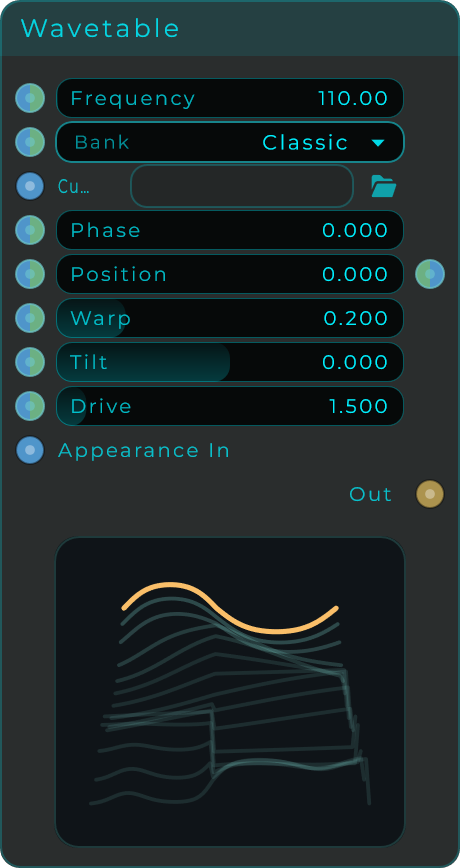
| Parameter | Range | Default | Description |
|---|---|---|---|
| Frequency | 0 - 20,000 Hz | 110 Hz | Base frequency |
| Phase | 0.0 - 1.0 | 0.0 | Phase offset in cycles |
| Position | 0.0 - 1.0 | 0.0 | Scans through the current wavetable stack. Modulate it for movement |
| Position Glide | 0 - 200 ms | 15 ms | How long Position takes to slide to a new value. On its own it makes no sound: it only shapes what happens while Position moves. At 0 ms Position jumps straight to its new value, which can click when a sequencer or a stepped CV feeds it. Raise it to hear the shapes melt into each other instead |
| Warp | 0.0 - 1.0 | 0.0 | Warps how the table is read out |
| Tilt | -1.0 - 1.0 | 0.0 | Tilts the harmonic balance. Negative is darker, positive is brighter |
| Drive | 0.5 - 12.0 | 1.0 | Final drive stage. At or below unity (1.0) it stays clean and linear; above unity it saturates |
| Bank | Choice | Classic | Which waveform family to scan through |
| Custom File | Audio file | Audio file loaded into the Custom bank | |
| Frame Size | Choice | Auto | How a Custom file is sliced into single-cycle shapes. Auto fits the file automatically and reads Serum or Vital tables correctly, so you rarely need to change it. Pick a size by hand if a custom file comes out sounding wrong |
| Reset | Button | Restarts the waveform from the beginning of its cycle. Handy for making every note start identically |
Available banks: Classic, PWM, Formant, Metallic, Harmonic, Vocal, FM, Reso, LoFi, Custom
While Bank is Custom and no file is loaded, the display says Drag your sound here. You can change that message in the Inspector, under Appearance → Empty Text. This helps when the display sits on a front panel and the file is loaded some other way: write Press Load, for example, or clear the text to show nothing.
Inputs: Frequency, Phase, Position, Position Glide, Warp, Tilt, Drive, Bank and Frame Size (all hybrid Data+CV), a Custom File input, a Reset input, plus an Appearance input that takes a JSON object for front-panel styling. Outputs: Out (mono audio). Position also has its own data output.
Wavefolding / West Coast
A voice in the "West Coast" style made famous by Buchla synths. Instead of taking a rich tone and filtering parts away, it takes a simple tone and folds and bends it to add richness and harmonics. The character here comes from reshaping the wave, not from removing anything.
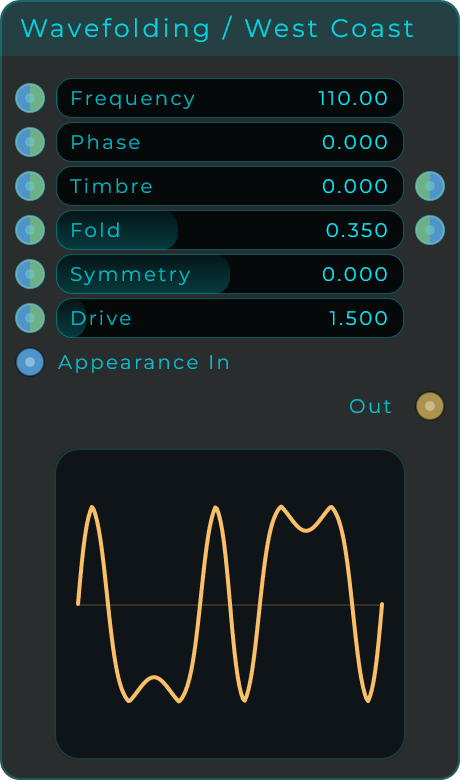
| Parameter | Range | Default | Description |
|---|---|---|---|
| Frequency | 0 - 20,000 Hz | 110 Hz | Base frequency |
| Phase | 0.0 - 1.0 | 0.0 | Phase offset in cycles |
| Timbre | 0.0 - 1.0 | 0.0 | Morphs the base source from sine toward a brighter triangle-like shape before folding |
| Fold | 0.0 - 1.0 | 0.35 | Wavefold amount. Adds repeated bends and harmonic complexity |
| Symmetry | -1.0 - 1.0 | 0.0 | Offsets the fold centre for more uneven, asymmetrical spectra |
| Drive | 0.5 - 12.0 | 1.5 | Final nonlinear drive |
Inputs: Frequency, Phase, Timbre, Fold, Symmetry and Drive (all hybrid Data+CV), plus an Appearance input that takes a JSON object for front-panel styling. Outputs: Out (mono audio). Timbre and Fold also have their own data outputs.
Fart Machine
A playful fart synth. It builds each sound from a quick puff of air, a low flappy body and a noisy tail. Sillier than it sounds useful, but it is genuinely handy for cartoon sound effects, comedy build-ups and goofy transitions.
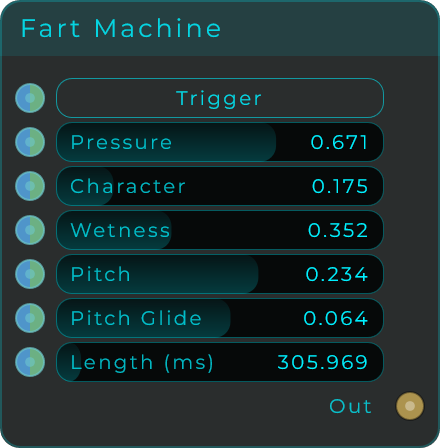
| Parameter | Range | Default | Description |
|---|---|---|---|
| Trigger | Event | Fires a new fart. Also accepts a rising CV/data pulse | |
| Pressure | 0.0 - 1.0 | 0.671 | How forceful the burst is |
| Character | 0.0 - 1.0 | 0.175 | Overall flavour, from crackly through classic to balloon-like |
| Wetness | 0.0 - 1.0 | 0.352 | How wet and bubbly the sound is |
| Pitch | -1.0 - 1.0 | 0.234 | Shifts the pitch up or down |
| Pitch Glide | -1.0 - 1.0 | 0.064 | Direction and amount of the pitch slide across the event |
| Length (ms) | 1 - 4,000 ms | ~306 ms | Overall duration of the event |
Inputs: Trigger, Pressure, Character, Wetness, Pitch, Pitch Glide and Length (all hybrid Data+CV). Outputs: Out (audio).
Formant Synthesis
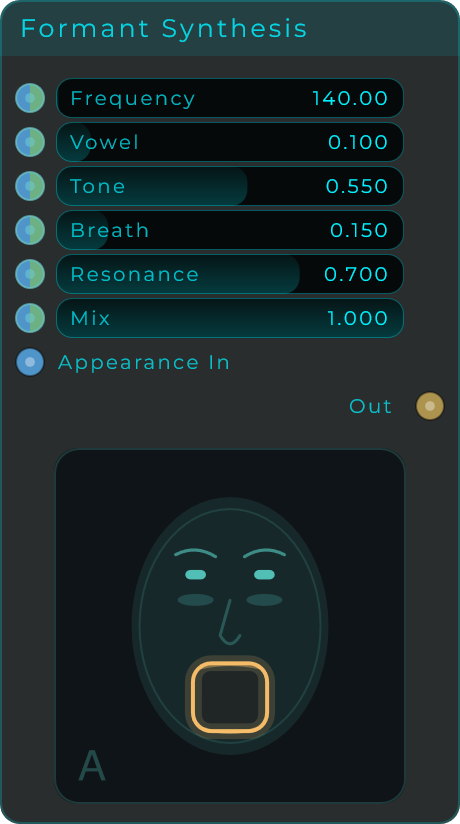
A voice built to make vowels and speech-like sounds. It shapes a voice-like tone through moving filters tuned to the resonances of the human voice. Sweep the Vowel control to get talking, singing and robot-voice effects.
| Parameter | Range | Default | Description |
|---|---|---|---|
| Frequency | 0 - 20,000 Hz | 140 Hz | Base pitch of the voice |
| Vowel | 0.0 - 1.0 | 0.1 | Sweeps the vowel shape (A, E, I, O, U) |
| Tone | 0.0 - 1.0 | 0.55 | Brightness of the voiced source |
| Breath | 0.0 - 1.0 | 0.15 | Amount of breath noise |
| Resonance | 0.0 - 1.0 | 0.70 | Sharpness of the formant peaks |
| Mix | 0.0 - 1.0 | 1.0 | Blend between the raw source and the formant-filtered voice |
Inputs: Frequency, Vowel, Tone, Breath, Resonance and Mix (all hybrid Data+CV), plus an Appearance input that takes a JSON object for front-panel styling. Outputs: Out (audio).
Karplus-Strong
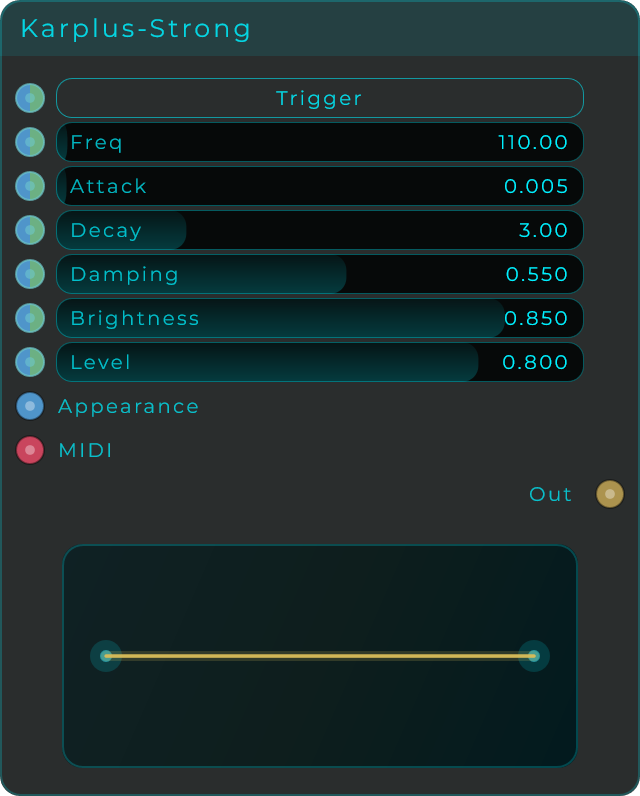
A plucked-string voice that recreates a real string with clever math instead of recordings. It starts a string ringing with a quick burst of noise, giving you acoustic guitar, koto, dulcimer and harp-like tones with no samples at all. It can play several notes at once over MIDI and uses very little CPU.
Decay reaches a full minute, and Sustain goes further: it holds the loop against both Decay and Damping, so with it up the string never dies and the node becomes a drone or a resonator to feed other sounds into. Being a control of its own (rather than the last notch of Decay) means you can modulate or gate it, which is how you get a string that rings while a pad is held and releases when it stops.
| Parameter | Range | Default | Description |
|---|---|---|---|
| Trigger | Event | Plucks the string. Any event or value of 0.5 or higher fires it | |
| Freq | 24 - 4,000 Hz | 110 Hz | String pitch |
| Attack | 0.0 - 0.25 s | 0.005 s | Softens the onset by fading in the pluck |
| Decay | 0.05 - 60.0 s | 3.0 s | Approximate ring time before the note fades roughly 60 dB |
| Sustain | 0.0 - 1.0 | 0.0 | Holds the string against Decay and Damping. At 0 it fades naturally; at 1 it rings on for as long as you leave it |
| Damping | 0.0 - 1.0 | 0.0 | Darkens the feedback loop. Higher is softer and duller |
| Brightness | 0.0 - 1.0 | 0.85 | Keeps more high harmonics in the excitation and loop |
| Level | 0.0 - 1.0 | 0.8 | Output gain |
| Voices | 1 - 16 | 8 | Maximum simultaneous strings (inspector only) |
Inputs: Trigger, Freq, Decay, Sustain, Attack, Damping, Brightness and Level (all hybrid Data+CV), a polyphonic MIDI input (NoteOn plucks a string at the note pitch, NoteOff releases it to its natural decay), plus an Appearance input that takes a JSON object for front-panel styling. Outputs: Out (mono audio).